
Our team at Phīla Engaged Giving has been fortunate to advise many generous wealth holders who want to ramp up their philanthropy by starting a foundation or launching an ambitious new giving initiative.
Their primary motivation is typically to have a positive impact on a community or issue they care about.
Following close behind is often an admirable desire to unify their family around the shared purpose of directing their resources to organizations working to make the world a better place.
Yet without careful planning that acknowledges inter-personal tensions, competing priorities, and differing values, trying to coalesce family members around a giving strategy can exacerbate divisions rather than overcome them.
Problems can also arise if leadership of a family philanthropy transitions to a new generation that is not properly prepared and doesn’t have the skills necessary to evolve and implement a shared family vision.
I’m pleased to share that we’ve developed a new tool to help families and their advisors overcome these challenges.
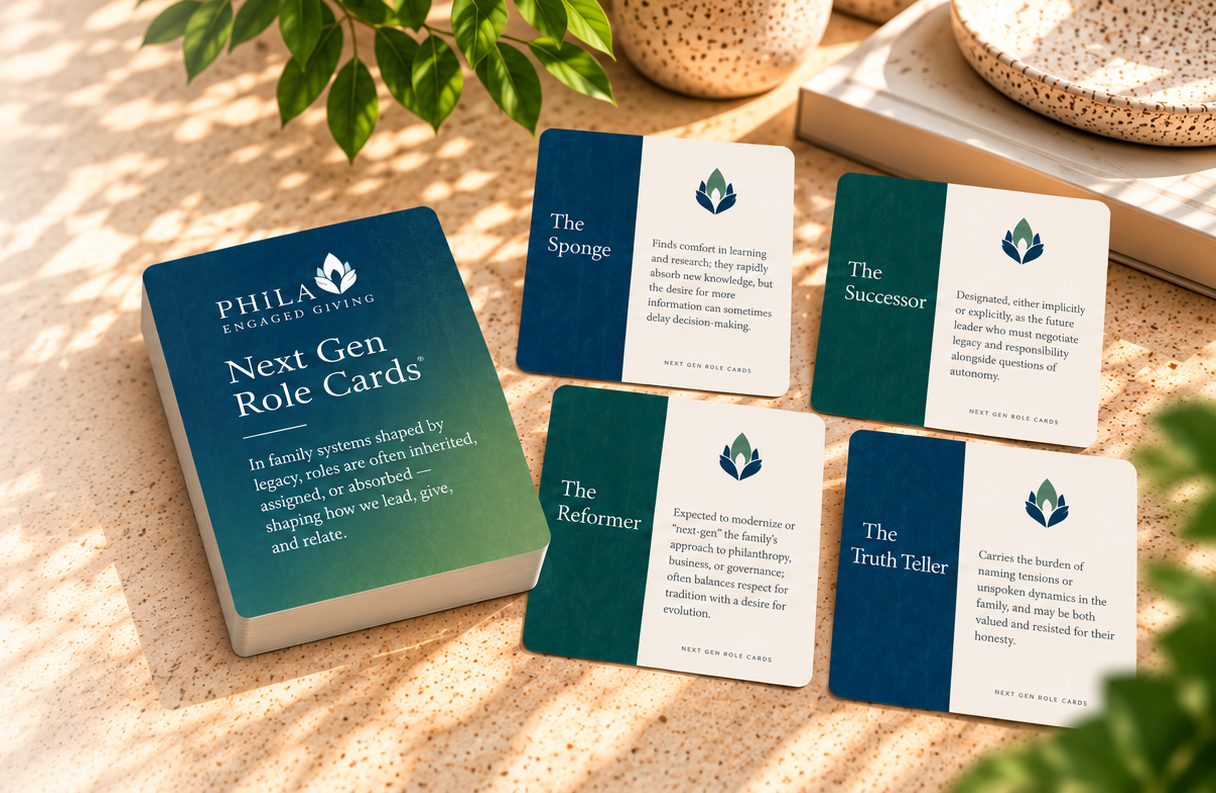
The Phīla Next Gen Role Cards leverage what we’ve learned from our client engagements about what works to navigate these often tricky conversations.
One example is the Scott family, which nearly sunset its foundation after the patriarch passed away and members of the family’s third generation couldn’t agree with new trustees on an updated mission and path forward. As we detail in a case study on our website, we facilitated a collective thinking process that brought out the best in each family member and led to the creation of a new mission statement, defined program areas, and a robust plan to guide their future giving.
Earlier this year I facilitated a workshop on these important topics with members of the Giving Pledge and their Next Gen community, who encounter such challenges just like many other families.
To guide conversations like these, our team developed the Phīla Next Gen Role Cards as a conversation tool to help families and advisors surface family dynamics, talk about them with greater honesty and curiosity, and create more space for each person to participate in philanthropy on their own terms.
The cards are based on a simple truth we’ve learned from our philanthropic advising: While every family is unique, most have familiar roles.
The Peacemaker. The Successor. The Reformer. The Caregiver. The Black Sheep.
Some roles we choose. Others are handed to us—sometimes long before we realize it. And when families come together to make decisions about wealth, values, legacy, and giving, those roles often come right along with us.
The cards helped open conversations that might otherwise have been hard to begin. They also helped families explore identity and leadership structures, navigate succession and changing dynamics, and consider how they want to participate in philanthropy on their own terms.
The cards proved sufficiently popular that we have adapted them and are now excited to offer them for sale on our website to families, next gen givers, professional advisors or anyone else who wants help navigating challenging conversations that can get in the way of cultivating a shared philanthropic vision.
I am also looking forward to leveraging the cards this month at the National Forum on Family Philanthropy in Philadelphia, where I will be co-leading a workshop with rising gen, Sloan Dickey, on the topic of “Leading With Authenticity” for next gen inheritors.
We have seen again and again that philanthropy is never only about where a family gives its money. It is also about identity, relationships, power, responsibility, and belonging.
The Phīla Next Gen Role Cards grew out of our work helping families navigate those intersections.
Our hope is simple: to give families a way to see their dynamics more clearly, talk about them more openly, and make more intentional choices about how they want to move forward together.